
Reading Time: 7 minutes
Key Topics: Dining Master Planning, Meal Plan Access, Labor and Resource Constraints, KPIs and Performance Tracking
Featured Interview: Christopher Henning, Executive Director of Dining, UC Berkeley Dining, in conversation with Sojo Alex, Managing Director, Envision Strategies
Watch the Full Video Interview Here
A Growing Program in a Dense Urban Campus
UC Berkeley serves a little over 45,000 undergraduate and graduate students. Its dining program supports more than 12,000 meal plan holders across four dining commons, four convenience-focused retail stores, and a growing lineup of campus restaurants, with a sixth location on the way. A full-service catering operation rounds out the portfolio.
Christopher Henning, Executive Director of UC Berkeley Dining, arrived about six years ago after time at the University of Illinois Urbana-Champaign. He has worked “just about every position in a kitchen at some point or another,” and that operator’s perspective shows in how he talks about the work. In a recent conversation with Sojo Alex, Managing Director at Envision Strategies, Henning walked through what it has taken to rebuild the program’s foundation while the campus around it keeps changing.
How Do You Make a Meal Plan Work When Dining Is Decentralized?
Berkeley’s dining commons sit on the edges of campus, while most student activity happens at the core, especially at midday. When Henning arrived, meal plans could only be used at locations owned and operated by dining. “It was hard for students to really get back to those dining commons to fully utilize their meal plans,” he explains.
The team responded in two ways. First, they introduced meal exchanges at select retail and campus restaurant locations, so a student can use a swipe for a combo such as an entree, sides, and a beverage.
Second, they partnered with GrubHub to let students spend a portion of their declining balance dollars at participating restaurants on or off campus, including back home during breaks. The decision reflects the area’s culinary scene. “Alice Waters is just a few blocks down the street from us,” Henning says. “Part of our philosophy was giving students access to enjoy some of those great culinary experiences.”
The result has been stronger participation, particularly among off-campus students who are not required to buy a plan.
Planning for Rapid Growth
Berkeley is working to guarantee housing for first-year students who want it, and the campus is “busting at the seams.” Several projects will reshape dining demand in the next few years.
Across the street from a dining commons, the new apartment-style residence at the former People’s Park site will include a cafe built for apartment living, offering groceries, meal kits, and a small quick-service operation. The Bancroft Fulton project will add roughly 1,500 beds focused on first-year students along with a split-level dining commons featuring five distinct concepts and about 500 seats. A separate 165-seat campus restaurant with no housing attached rounds out the pipeline.
Land is scarce, so Berkeley is building up. Carry-out and to-go service are designed in from the start. “Convenience is probably one of the most important things to our students,” Henning notes.
What Did the Dining Master Plan Reveal?
Berkeley’s dining master plan study, completed with Envision Strategies, set out to answer two questions: how to grow responsibly without cannibalizing existing operations, and where the program stood today. The original scope leaned heavily toward facilities. The study grew from there.
The campus had gone a couple of years without a dining director, so there was no handoff when Henning arrived. “As we got into the study, it became more about what are the operational things that we have to address? Where are the gaps?” he recalls. Some of those gaps were basic day-to-day operations. Others were financial, since many campus structures are “not geared to a P&L.” Working with finance partners to build a roadmap and guiding principles became a priority, and the study helped the team decide “what are the top burning priorities.”
Looking back, Henning would change two things. He would hire key roles earlier, including Brian Muganda Ashiali, Business Improvement Analyst, a data specialist who supports project management, systems, and analysis. “A lot of that information would’ve been helpful early on and would’ve sped up the process,” he says. He would also cast a wider net with campus stakeholders, such as capital projects, from day one. “I failed to understand the importance that some of our campus colleagues and stakeholders placed on this study,” he admits, noting that earlier input could have prevented a few pivots.
Overcoming Resource Roadblocks
Henning names three constraints, and labor accounts for two of them.
Culinary recruitment. Even in the Bay Area, skilled culinary talent is hard to find. Henning’s own alma mater, New England Culinary Institute, closed after the pandemic, and fewer people are willing to take on expensive culinary degrees. His answer is to build skills in-house. “We can’t rely or wait on outside culinary programs or skilled staff to come to us. I think we need to bring the staff in and give them those skill sets,” he says, pointing to UCLA’s culinary training program as a model and identifying a culinary trainer role as a key addition.
Cost of labor. With California fast food workers earning $20 an hour, Berkeley has to stay competitive while paying a fair, living wage. That has meant decisions Henning might not have made earlier in his career, such as buying pre-cut vegetables. “We’ve done the math, and it works out for us,” he explains. It also reduces repetitive injuries. The team is also exploring where technology fits, from GrubHub and to-go ordering to frictionless options like Amazon Just Walk Out. The goal is to shift staff toward “job responsibilities that are value-added,” creating something closer to a concierge experience than a transaction.
Deferred maintenance. Like many campuses, Berkeley is working to reinvest in aging facilities. For Henning, that comes back to budgeting discipline and “being good stewards of our resources,” setting money aside for capital projects while managing the two biggest controllables: labor and food.
Which KPIs Matter Most for a Campus Dining Program?
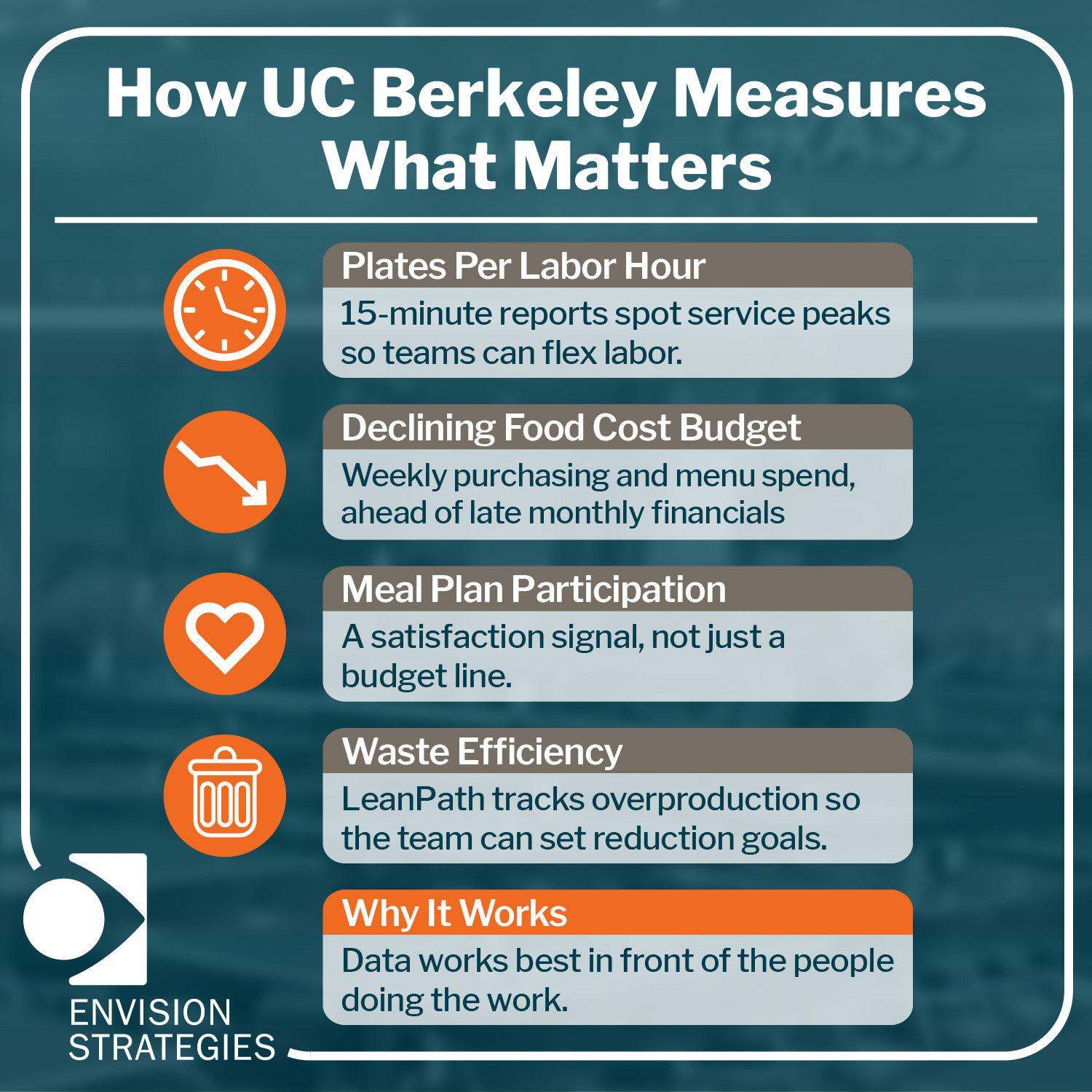
Tracking performance is where Berkeley has invested the most time since the master plan. Henning highlights four measures.
Plates per labor hour. “First you gotta have the report and the dashboard that shows that,” Henning says. Managers use 15-minute reports to spot service peaks and a staffing calculation tied to customer counts. Student schedules, built in one- and two-hour blocks, give the team room to flex labor during slower periods.
Declining food cost budgets. Monthly financials often arrive one or two months late, which is too slow to act on. Berkeley built a model that pulls spending from purchasing and menu management data into a sheet compared against budget, so teams see week to week what they have spent and what remains. It has been piloted in campus restaurants and is rolling out to the dining commons.
Waste efficiency. California law requires tracking waste and donating a share of it. Berkeley goes further, using LeanPath to measure overproduction and building an efficiency ratio of dollars spent versus dollars wasted, which lets the team set reduction goals.
Meal plan participation. Developed with IT partners, this metric is “not just a budgetary tool,” Henning explains. “It’s also an indicator of do our students like us?”
Much of this lives in Tableau dashboards. At Henning’s level, one favorite compares where students live with where they eat.
Advice for Dining Leaders in the Trenches
When Henning started, someone told him, “When you work at Berkeley, it’s all about the relationships.” He believes that holds true anywhere. A talented, passionate team matters, and so do strong ties with finance, IT, and capital projects. “There has to be an investment in understanding other people’s work, and getting to know your campus partners, and being able to share your story and listen to theirs,” he says. Without buy-in, even good changes can stall.
He also urges patience. “It’s a marathon, not a sprint. Celebrate the small wins, and don’t get discouraged by getting overwhelmed by the big picture and the big lift.”
To learn more about UC Berkeley Dining, visit dining.berkeley.edu.
Key Takeaways for Dining Leaders
- Bring meal plans to where students are: Meal exchanges and off-campus dollar options can lift participation when dining halls sit away from the center of campus.
- Scope a master plan beyond facilities: Operational and financial gaps often matter as much as space and growth.
- Hire data talent and engage stakeholders early: Early analysis and early campus input reduce mid-course pivots.
- Grow your own culinary talent: In-house training programs can fill gaps that outside culinary schools no longer cover.
- Revisit old assumptions about labor: Pre-cut produce and targeted technology can save money and reduce injuries without compromising quality.
- Put real-time numbers in front of the people doing the work: Declining budgets and 15-minute reports let teams adjust before monthly financials arrive.
- Treat participation as a satisfaction metric: Meal plan participation shows whether students see value in the program.
- Invest in relationships and celebrate small wins: Campus partnerships make change possible, and steady progress sustains the team.