Reading Time: 4 minutes
Key Topics: Staffing Challenges, AI Integration, Student Experience, Technology Balance
Featured Interview: Anthony Coschignano, Swarthmore College
Watch the Full Video Interview Here
The Swarthmore Campus
Swarthmore College is a small private institution with about 1,680 students, 97% of whom live on campus. That deeply residential character shapes every aspect of how auxiliary services operate.
Anthony Coschignano serves as AVP of Campus Services, overseeing a broad portfolio: dining, public safety, a 40-room inn with a full-service restaurant, the campus bookstore, post office, events management, performing arts production, OneCard programming, and fleet management.
The campus recently opened a new dining hall and campus life center featuring nine different stations and a teaching kitchen.
The Staffing Challenge Everyone Shares
When asked what operational challenge he’d fix with a magic wand, Coschignano points to what nearly every auxiliary leader is facing: staffing shortages.
“It’s really a hard time finding people that want to work nights, weekends,” Coschignano explains. “The part-time jobs are really harder to fill these days.”
Finding new staff is difficult. Retaining existing staff proves equally challenging when competitors offer Monday-through-Friday, 9-to-5 schedules that campus operations can’t match.
AI Tension
Compounding the staffing shortage is an emerging tension around technology. As campuses explore automation, existing staff fear their jobs are being eliminated.
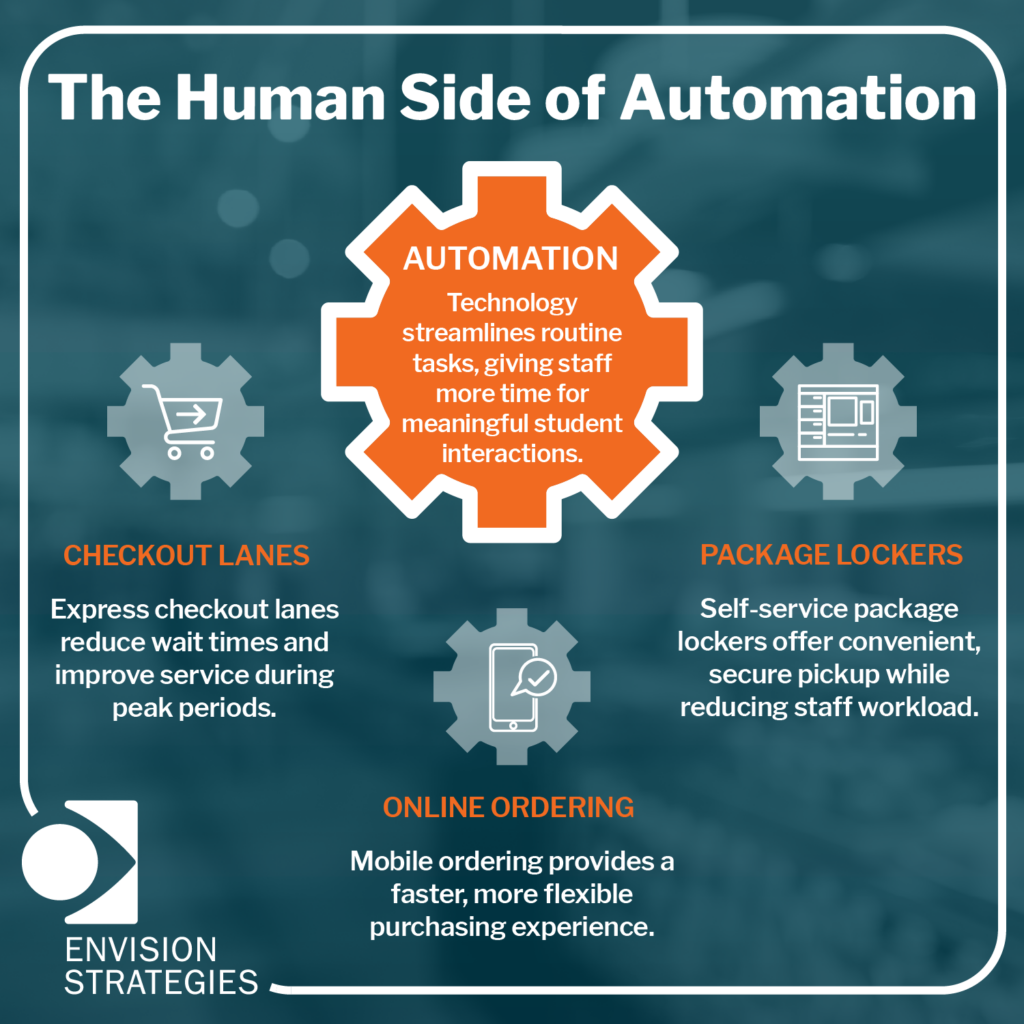
Swarthmore experienced this directly when they installed express checkout lanes in the new dining hall. The immediate reaction from cashiers: “You don’t want us to work anymore.”
“We’ve said, no, we still need people to talk to people and connect,” Coschignano explains. “But this is about getting people through the lines.”
His philosophy centers on using technology to reassign staff to higher-value work rather than reducing headcount.
“The biggest challenge when you think about opportunities is this loss of touch, the service touch,” Coschignano notes. “Once that goes away, a computer’s not going to deal with you as a person and calm you down.”
Human Connection Still Matters
For students dealing with stress and academic pressure, dining staff often serve as unexpected points of connection.
“A lot of the dining staff knew students by name, what their classes were, what was going on in their lives,” Coschignano recalls. “And now you have students just walk by with their phones.”
The moments when a dining staff member greets a student by name carry real weight in a campus environment where personal connection increasingly competes with screens.
Smart Technology Deployment
Where Swarthmore has found success, is deploying technology in areas where automation genuinely improves experience without sacrificing service quality.
The post office is moving from traditional keyed mailboxes to locker systems. Students picking up packages don’t need to interact with anyone. But those needing assistance still have staff available.
The campus bookstore follows a similar model. Students place orders online, staff assemble everything, and pickup still involves a human touchpoint.
“There’s a point where they still have to interact with somebody,” Coschignano explains. “If they have a question about it, there’s someone there to help them.”
Swarthmore is also relocating the post office near the new student center and dining hall, creating a one-stop nucleus where students naturally gather and access services in one cluster.
What This Means for Auxiliary Leaders
Automation should address throughput, not replace connection. Express lanes and self-service options help manage volume. They shouldn’t eliminate the human interactions that define campus hospitality.
Name the fear directly. When staff worry about job elimination, address it honestly. Explain what technology handles and why human service remains essential.
Deploy technology where it genuinely improves experience. Package lockers, online ordering with human pickup, express checkout. Find the spots where automation removes friction without removing people.
The service touch is your competitive advantage. Technology can’t replicate a staff member who knows a student’s name. Protect that capability even as you automate elsewhere.
The Human Element
What Coschignano articulates is the central tension facing every auxiliary operation: campuses need technology to manage staffing shortages, but the human connection that makes campus services meaningful can’t be automated.
Getting that balance right requires intentional choices about where technology adds value and where people remain irreplaceable. Swarthmore is finding that balance one decision at a time, always returning to the same question: does this serve students better while preserving the connections that matter?