Reading Time: 4 minutes
Key Topics: Allergen Management, Student Recruitment, Dining Technology
Featured Interview: Bill Legett, Director of Event Management, Dining and Hospitality, Illinois State University
When Bill Legett’s team at Illinois State University set out to redesign their servery a few years back, the goal was straightforward: build a venue that could serve students with food allergies safely. What they got instead was one of the most popular stops on campus, allergies or not.
“What surprised us the most was that students, first and foremost that need the program, is the selling point,” Legett says. “But what we didn’t realize is how popular it would be with students with no allergen dietary needs.”
A Venue Built on Listening
Illinois State serves 21,000 students out of Bloomington-Normal, a couple hours south of Chicago. The dining program covers residential, retail, and catering, along with the events inside the student center. The idea for what eventually became Station Nine came directly from student feedback about allergens.
The team started small: dietitians on staff, individual meal planning for students with the most serious needs, and a mix of venue options. One venue, originally called Station Eight, was built to be free of the top eight allergens. When sesame joined the federal allergen list, the name became Station Nine.
For families dropping students off at college, that kind of venue answers a question that weighs heavily long before move-in day. “Especially parents, when they’re dropping off Johnny or Susie at college, they’re really worried about whether or not their dietary needs are going to be met,” Legett explains.
The Part Nobody Planned For
Here is the twist. Plenty of students with no allergies at all started eating there too, some without even realizing what made the venue different.
“We’ve talked to many students that just thought Station Nine was a name, just like it would be a variation of the home style station that a lot of colleges have,” Legett says. He mentions students who had eaten vegan cheese there for weeks before realizing it, and simply thought the food was good.
That is the outcome every allergen-friendly venue hopes for: safety that never announces itself, wrapped inside food people choose to eat anyway.
Support That Starts Before Move-In
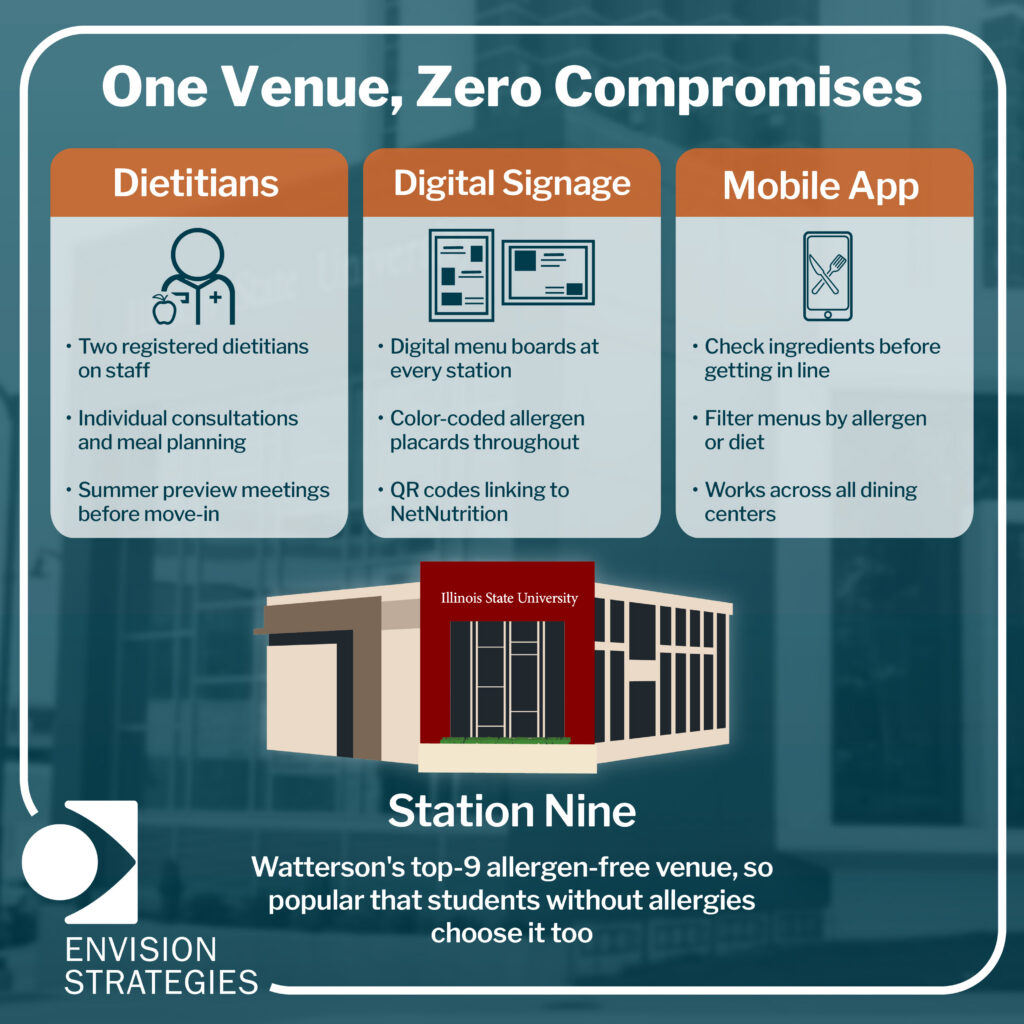
Illinois State backs the venue with two dietitians, one of whom works directly with students who need daily meal planning. Many of those same students meet with their dietitian during summer preview, before their freshman year even starts, and learn to navigate the university’s NetNutrition system so they can eat safely across every dining center, not just Station Nine.
Technology reinforces all of it. When the university refreshed its dining spaces, digital menu boards went up at every station, including Station Nine, listing everything being served. A university app launched last year gives students an even easier way to check what is in their food before they get in line.
Why It Works
Station Nine succeeds because Illinois State treated allergen management as a program, not a single venue. The dietitians, the digital signage, the app, and the physical space all work together, and none of them depend on a student announcing that they have an allergy to benefit from the system.
It also points to something bigger for campus dining leaders: build for the students who need it most, and you often end up building something everyone wants.and retaining students depends fundamentally on whether auxiliary services create environments where students feel they belong.