

Michigan’s Steve Giardini on why flexible design, not more square footage, is the answer to a dining program in constant motion.
Reading Time: 3 minutes
Key Topics: Facility Design, Operational Flexibility, Retail vs. Residential Dining, Labor and Automation
Featured Interview: Steve Giardini, Senior Director, University of Michigan
Interviewed by: Sojo Alex, Managing Director, Envision Strategies
Watch the Full Video Interview Here.
A Program in Constant Motion
Ask Steve Giardini to describe the University of Michigan’s dining operation and the numbers come first. Thirty-one kitchens across the buildings his team operates. More than 500 full-time staff. Another 1,300 to 1,400 students on the payroll.
“Lots of things always happening on campus on our end,” he says.
Two more facilities are on the way: one opening next year, and a different kind of facility three years after that. Which means Giardini spends real time on a question most operators only ask in the abstract. Look at your dining facilities five years out. What has to be absolutely different?
Flexibility Is the Hedge
His answer is not a concept, a cuisine, or a piece of technology. It is the ability to change his mind later.
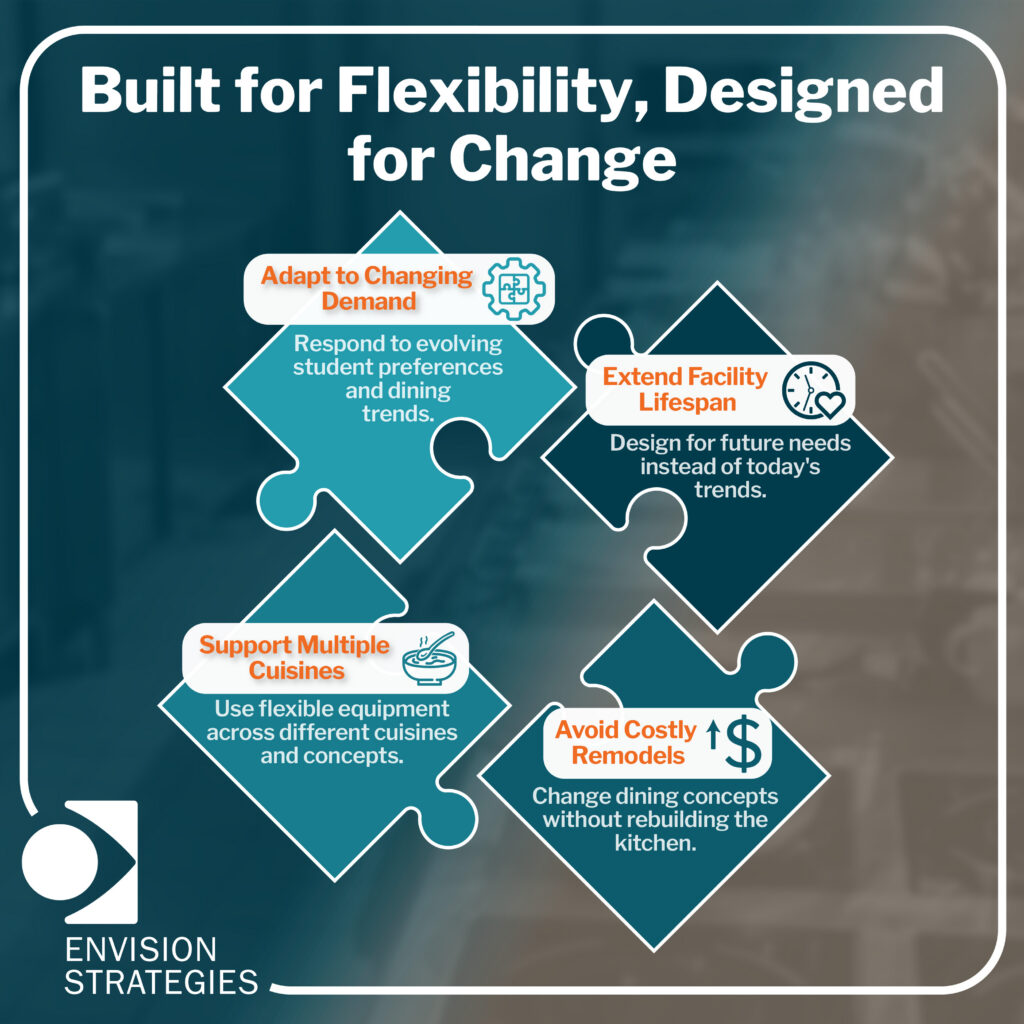
“It really comes down to building and designing a space that can be flexible,” Giardini says. That starts with equipment specified to move between cuisines rather than lock into one, “allowing us to be nimble in responding to consumer demands and what students are after, whether it’s a particular type of ethnic cuisine or just something that they want to build and customize themselves.”
The financial logic is blunt. “For us, it’s about being able to be flexible and not having to spend a bunch of money remodeling when we come up with something new we want to do.”
That reframes the capital conversation. A facility designed around today’s most popular concept is a facility with a remodel already scheduled. One designed around change absorbs the next trend without a construction budget attached.
Same Students, Different Rooms
Flexibility looks different across residential and retail. “They’re the same, but they’re different,” Giardini says. His team deliberately keeps the two distinct: “We don’t do a lot of what we do in retail in our dining halls and vice versa.”
The reason is audience. Dining halls serve meal plan holders. Retail serves a broader mix of campus guests, visitors, and staff. Each gets an experience crafted for who actually walks in.
What carries across both is the standard. “It’s really about flavor and choice, and making sure they can find something that speaks to what they want to eat at that moment in time.”
And the bar is set by frequency. Students eat with Michigan Dining 15 to 20 times a week. “We gotta keep it new and fresh and make sure there’s always something available.”
The Labor Question Behind the Design
Every flexible design decision eventually meets a staffing plan. Giardini named that pressure without hedging.
“It’s the thing that keeps me up at night,” he says, “as we open this new facility next year, and finding 100 people to staff that on a permanent basis.”
His response is to solve for it at the design table rather than after opening: staying current on automation while facilities are still being drawn, and being deliberate about where technology belongs. “With regards to our back-of-house processes, trying to be smart about how we use AI and really using it to automate some of the work that we’re doing so that our chefs can spend more time with our teams and more time with our guests, and really putting hospitality sort of back at the front.”
It is a useful framing. Automation is not positioned as a headcount substitute. It is positioned as a way to move skilled people out of production tasks and back in front of students, which is the part of the job no system replaces.
The Takeaway
For programs heading into capital projects, Giardini’s point lands cleanly. The most valuable thing a new facility can offer is not a concept students love today, but the flexibility to evolve when their needs inevitably change.


