

Reading Time: 4 minutes
Key Topics: Operational Efficiency, Facility Design, Student Workforce Development, AI & Menu Analytics
Author: Sojo Alex, Executive Principal, Envision Strategies
Featured Interview: Garrett DiStefano, Director of Residential & Retail Dining Services, University of Massachusetts Amherst
Watch the Full Video Interview Here
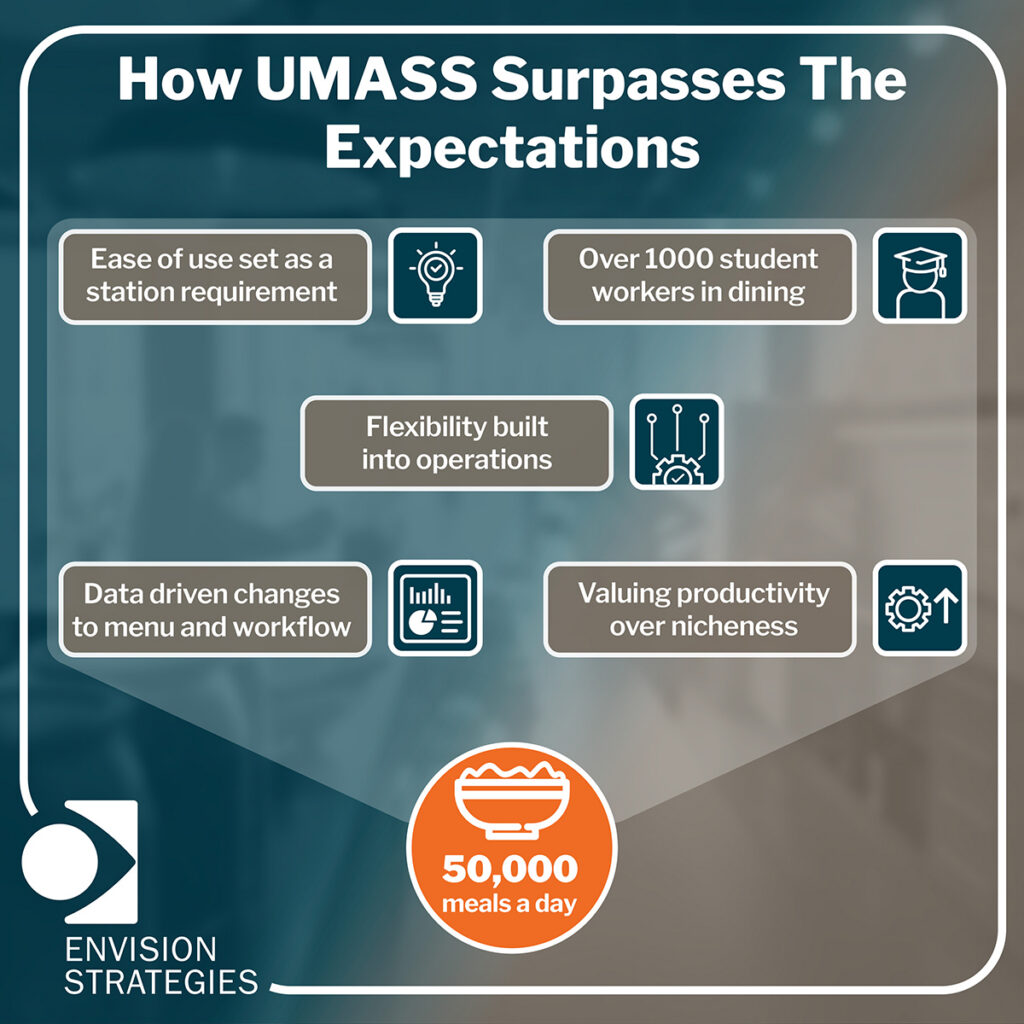
UMass Dining serves more than 50,000 meals a day. At that volume, the gap between a station that works and a station that almost works isn’t a rounding error. It’s the entire daypart.
So we asked Garrett DiStefano, Director of Residential & Retail Dining Services at UMass Amherst, a single question: looking at his dining facilities five years from now, what’s the one thing that absolutely has to be different? His answer had less to do with new equipment than with how much a single serving station can reasonably be asked to do.
Ranked First, Still Asking What’s Next
UMass Amherst has held the Princeton Review’s number one ranking for Best Campus Food in the nation for nine consecutive years, built on food that is healthy, sustainable and delicious, and on a commitment to global cuisine served with genuine authenticity.
What stands out is how Garrett frames the purpose behind that. The goal isn’t satisfaction scores. It’s memory.
“Athletics is one of those things. Academics is one of those things. Why can’t dining be one of those things that students come back for and create that kind of alumni relations?”
That reframing has real consequences for how a program justifies investment. Dining positioned as an alumni-relations asset gets evaluated differently than dining positioned as a cost of doing business.
The Benchmark Was Set Before the Labor Market Shifted
UMass had the rare opportunity to build new. The Worcester Dining Common was the first new construction on campus in more than 50 years, designed in the 2018 to 2019 window with operational excellence and student engagement as the guiding priorities.
Those priorities haven’t changed. The conditions around them have.
“One of the things we have to look at now, especially how tight labor markets can be, is being able to extend productivity, getting efficiencies, while still delivering all of those wonderful things that the students want.”
Flexible Beats Specialized
The facility opened with a range of customization stations, each purpose-built. Garrett’s team is now asking a different question of that same footprint: not what a station does best, but how many hours of the day it can stay productive.
“How can we have operations that are very flexible in the way that they are, as opposed to being very specific about things?”
He points to the Mongolian grill era as the reference point for highly specific stations. Even UMass’s tandoor station, which he describes as wonderfully popular and especially meaningful to Muslim students, illustrates the tension. Specificity creates distinctiveness. It also creates equipment and labor that only earn their keep during a narrow window. Cross-training and fluidity across day parts are how the team is closing that gap.
Design for the Workforce You Actually Have
There’s a second constraint shaping station design, and it isn’t culinary. UMass employs roughly a thousand student workers, and the profile of that worker has changed.
“A lot of times now, as opposed to 10 years ago, you’re coming with students who have never had a job before. So teaching them, training them, the station not only has to be flexible, but it also has to be easy to operate.”
Ease of operation as a design requirement rather than a nice-to-have. That’s a meaningful shift, and it collides with a rising expectation on the other side of the counter.
“You have students who are much more aware of what food needs to taste like, but we also have to have the stations that are able to accommodate them and be flexible with them while focusing on efficiencies.”
More sophisticated palates. Less experienced labor. Tighter margin expectations from above. As Garrett puts it plainly: “If you’re looking at what our administrators are asking of us, more margin. Auxiliaries have been asked to deliver more and more over the years, and now we have to figure out better ways to do that.”
Where AI Actually Earns Its Keep
Garrett is measured about technology. “People like to use AI as the all-fix of all things,” he notes, before making the case for a narrower and more useful application.
The work starts upstream, in menu planning, menu engineering and waste management. Waste measurement isn’t new; systems have done it for years. What’s newer is what he calls the likability view.
“We knew through service records what things were going to be, but now we can know specifically, as opposed to more generically, which menu items worked well and which menu items did not work so well.”
The value isn’t the data point. It’s the ability to act on it while the menu cycle is still live.
“Being able to dynamically change your menu, to start to look at some of those efficiencies and start to cut back at some of those costs that otherwise were opportunity costs you never knew existed in the first place, because you were never able to measure them.”
Takeaways for Dining Leaders
- Make the alumni case, not just the satisfaction case. Programs framed as long-term institutional assets compete better for capital than programs framed as service lines.
- Evaluate stations by day-part productivity, not peak-hour performance. A station that excels for 90 minutes and sits idle for six hours is a labor and capital problem in a tight market.
- Treat ease of operation as a design specification. If a meaningful share of your workforce has never held a job, training burden belongs in the equipment conversation.
- Measure likability alongside waste. Waste tells you what came back. Likability tells you what to change, and lets you change it mid-cycle.


