Reading time: 7 minutes
Key topics: Student success, food insecurity, campus collaboration, voluntary meal plans, partner transparency, KPIs, dining services ITN/RFP
Featured interview: Ann Roebuck, Vice President, Envision Strategies, with Matt Mueller, Director of Food and Beverage Services, University of Florida
Watch the Full Video Interview Here
At the University of Florida, dining is measured by more than meals served. Matt Mueller, Director of Food and Beverage Services, oversees UF’s dining services partnership, pouring rights, vending, and a roster of about 75 approved off-campus caterers. In a conversation with Ann Roebuck, Vice President at Envision Strategies, Mueller explained how UF has grown a voluntary dining program by building partnerships across campus and holding every decision to one standard: is it best in class?
How Does Dining Support Student Success?
For Mueller, the answer starts with the mission. “Our mission, first and foremost, is to support our students on campus,” he said. That support works on several timelines. In the short term, it means keeping students healthy and nourished enough to have a successful day. Over the longer term, it means helping them get through a semester and, eventually, an entire academic career.
That broader view pulls dining into areas well beyond the dining hall, from food insecurity to partnerships with academic departments. “We want our students to thrive, and to graduate, and to build some great futures,” Mueller said.
How Is UF Addressing Food Insecurity?
Mueller described food insecurity as a need that grew sharply after COVID. UF’s approach starts with understanding which students are affected and what they need, then bringing partners together to respond.
The contributions come from several directions. Chartwells, UF’s dining services partner, donates meal swipes, and one of its burger concepts directs part of its proceeds to the campus pantry. The dining program also extends its buying power to the pantry so it can purchase supplies more efficiently. Beverage and vending partners, including Pepsi and Canteen, donated product after visiting the pantry and learning about its work.
The longer-term goal is prevention. “If a student identifies freshman year that they’re in need, how do we ensure that they aren’t in need for four years?” Mueller asked. He is working with other departments to identify at-risk students before they arrive on campus.
What Can Dining Learn From Other Campus Departments?
Much of UF’s progress comes from Mueller’s habit of learning what other departments do and what keeps their leaders up at night. One of the most memorable results came from UF’s agriculture school. As a land-grant institution, UF develops new crops, including a white strawberry known in Florida as the pineberry.
When Mueller asked why the fruit wasn’t in UF’s dining halls, the conversation turned into a partnership. The agriculture school brought pineberries to a dining hall, chefs developed recipes, and researchers surveyed students during lunch. A typical product survey might reach 100 students. That day, more than 800 students gave feedback. He described the flavor as a cross between a strawberry and a pineapple, and a natural fit for chocolate-dipped catering trays.
The model has since expanded. A later event let students sample and compare five varieties of Florida blueberries, and other student groups tabled alongside it. “Quite selfishly, how do we become the first one to have that product, play with it, test it, and put it in our dining program?” Mueller said.
How Does Dining Support Recruitment, Retention, and Reputation?
Mueller frames dining’s institutional value around three Rs. For recruitment, the question is how dining helps a prospective student choose UF over another school, including students with allergen or religious dietary needs and students who live on or off campus. For retention, dining builds the community and sense of belonging that make first-year students want to stay. For reputation, recognition from NACUFS and other organizations reflects well on the university as a whole.
With UF ranked among the top public institutions in the country, Mueller sees it as important that the dining program performs at the same level.
What Resource Roadblocks Does UF Dining Face?
Mueller named three. First, UF is a large state school with no housing requirement and no meal plan requirement, so every meal plan sale is voluntary. Second, UF offers some of the most affordable dining plans in the country, closer to $5,400 a year than the $8,000 seen at some top programs, while operating 40 locations across campus. Third, like every campus, UF has limited investment dollars and still wants the program to improve every year.
The voluntary model has turned into a growth story. With Chartwells marketing, selling, and educating students about meal plans, UF grew from about 3,500 annual meal plans to 7,300. “Number one, it’s gotta be about the program,” Mueller said. “Number two, it’s really changing meal plans and adapting meal plans to what students are looking for.”
Adapting plans to how students live
Those adaptations include all-access plans, expanded hours, and adjustments to meal equivalencies and exchanges. Top-tier plans can include membership-style benefits such as special event access and pop-ups. Pop-up locations now move to where students are: a residential area in the morning, the academic side at lunch, and a basketball game at night.
Demand also differs by cohort. Freshmen, and their parents, tend to choose all-access plans so they never worry about the next meal. Upperclassmen favor 10- or 14-meal-per-week plans with more flexibility for retail locations. UF also reworked its Greek plans with fraternities and sororities that already have required house meal plans, offering options such as lunch on campus or weekend meals when the house chef is off. “What do you really need, and how can we adapt to that?” Mueller said.
How Does UF Gather Student Feedback?
“Feedback is a gift,” Mueller said. UF collects it through a monthly food service advisory committee that includes students along with staff and faculty from academic and administrative departments. The team also meets monthly with resident advisors, runs annual surveys through Chartwells and a separate business services survey each spring, and offers daily feedback channels.
The goal is to find the useful nugget in every comment. If 20 students say nothing is open late at night, the team asks whether something is missing, whether students simply don’t know about an existing option, or whether part of campus is underserved. Incentives stay simple: giveaways during surveys, meals for secret shoppers, and lunch or dinner at a different campus location for committee meetings. “Free food is always that gift that we can easily use to inspire some feedback,” Mueller said.
How Do You Keep a Dining Partnership Transparent?
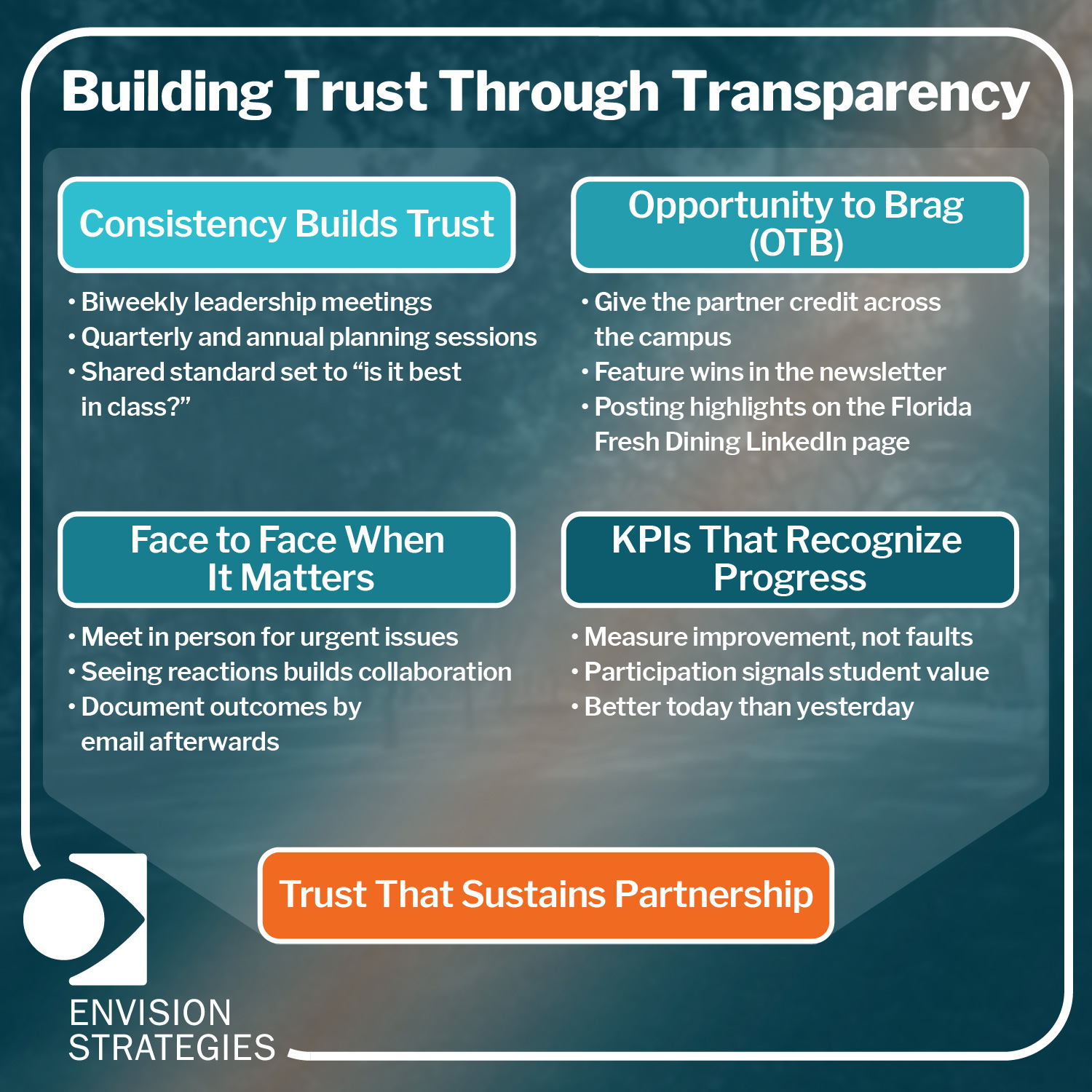
Mueller’s first answer is consistency. UF holds biweekly meetings with Chartwells’ on-campus senior leadership, plus quarterly, biannual, and annual recap and planning sessions with company leadership.
From “top 10” to “best in class”
Shared goals keep those meetings productive. Early in the partnership, conversations centered on reaching a top 10 dining ranking, a target no one could clearly define. UF shifted to a simpler standard. “We ask the question, ‘Is that best in class?'” Mueller said. “That’s probably a yes or no answer.”
KPIs that recognize progress
UF uses KPIs to gauge improvement rather than to find fault. Participation rate, the share of meals used, is one example. “We don’t set a goal that if you don’t hit this goal, you’re gonna be punished,” Mueller said. Hitting a KPI signals that students are finding more value in the program and recognizes the partner’s work. The guiding principle: today better than yesterday, this month better than last month, and this year better than the last.
Face-to-face when it matters
When an issue needs immediate attention, the team meets in person, then documents the outcome by email. Mueller believes seeing reactions and sharing the moment leads to better collaboration than a string of emails.
An Opportunity To Brag
UF also created OTB, or Opportunity To Brag, to give Chartwells’ team credit across campus. That might mean telling colleagues a dish was smoked for 12 hours or a dessert was made from scratch. OTB shows up in conversations, the business affairs monthly newsletter, event emails, and the Florida Fresh Dining LinkedIn page, which posts several times a week.
How Do You Work Across Generations on Campus?
Mueller enjoys the energy of a college campus, and he admits he often asks students whether they still use a certain term. Usually, they stopped years ago. His approach is to bring a range of voices to every conversation: students, faculty and staff, contracted partners, and outside experts.
He also asks clarifying questions. “If somebody says, ‘That stinks,’ that doesn’t necessarily help me understand,” he said. Industry publications, campus visits, and events such as NACUFS and NACAS conferences help him learn what other schools are experiencing with their own students.
How Can Dining Leaders Build Relationships Across Campus?
When Mueller arrived at UF, he made a point of meeting people across the university. “Hey, let’s go have lunch. I wanna learn about your area,” he would say, hen listen for the challenges each team was trying to solve.
One lunch with the food science and human nutrition college revealed that the program does not enroll freshmen and must recruit from current UF students. The fix was simple: table at a dining hall, at no cost, with desserts to draw people in and a lunch crowd of about 1,200 students. “Sometimes it may not be a dining solution,” Mueller said, “but just understanding what keeps people up at night.” A free coffee or lunch is rarely turned down, and it often opens the door to future collaboration.
What Is the Value of a Consultant in a Dining Services RFP?
Mueller and Roebuck worked together on UF’s dining services ITN, or invitation to negotiate, which many campuses call an RFP. Mueller said the most important benefit was an outside perspective that could gather input from every corner of the program. UF’s committee had 17 members from across campus, each with a different view of what dining should be.
Having someone “take all those different things and say, ‘Okay, let’s put it all together in one neat package'” helped UF find a partner aligned with its goals. Envision Strategies also brought insight from other campuses on decision-making, trends, and contract terms. “It was kind of packaged for us to be able to absorb and to use effectively,” Mueller said.
The main lesson was about timing. The process ran about a year to a year and a half from bid to final contract during the post-COVID period, and the financial landscape shifted along the way. Keeping every decision tied to a best-in-class program helped both sides adapt and reach a strong partnership.
Mueller credits that partnership, and many others, for UF’s progress. “It’s not me, it’s our partners,” he said. Contracted partners and university departments now share a common vision: a dining program that gets better every year and supports student success.
Key Takeaways
- Bring in outside expertise for an RFP. A consultant can unify many campus voices into one clear document and share what peer institutions are doing.
- Define dining by student success. Support students day to day, semester to semester, and through graduation.
- Bring partners to the problem. Food insecurity responses work best when dining partners, vendors, and campus offices each contribute what they do well.
- Ask what keeps others up at night. Some of the best collaborations, like the pineberry tasting, start with curiosity about another department’s work.
- Adapt plans to real student life. Voluntary meal plan sales grow when plans, hours, and locations match how each cohort actually eats.
- Use a standard everyone understands. “Is it best in class?” is easier to act on than a ranking target.
- Treat KPIs as recognition. Measure improvement and celebrate the partner when goals are met.