Reading Time: 4 minutes
Key Topics: Student Expectations, Transparency, Stakeholder Engagement, Governance and Buy-In
Author: Sojo Alex, Managing Director, Envision Strategies
Featured Interview: Erik Russell, Assistant Vice President, Hospitality and Auxiliary Services, Occidental College
Watch the Full Video Interview Here
Occidental College enrolls roughly 2,000 students and runs one a la carte dining hall plus a small retail space with a pizza oven and a grill. There is very little machinery sitting between a student’s complaint and the person who can act on it.
Erik Russell, Assistant Vice President of Hospitality and Auxiliary Services at Occidental College, treats that as an advantage. We asked him one question: what has changed about student expectations over the past two years, and how has his program responded? The answer he gave was less about menu trends than about who does the work of solving problems.
A Small Campus Inside a Large City
Occidental sits about six miles north of downtown Los Angeles, a fully residential liberal arts college with the intimacy that implies, dropped into one of the largest metro areas in the country. Barack Obama studied there, a detail Erik offers as the campus’ claim to fame.
The dining program is scaled to match. One a la carte hall carries lunch and dinner. The retail space, limited by equipment, mostly serves the late crowd.
That scale sets the terms for everything that follows. “Being a small campus, that allows us to be flexible. It allows us to move quickly. It allows us to be nimble. It allows us to get feedback real quick.”
What Actually Changed
Erik’s read on the past two years centers on value, and specifically on the perception of value.
“It’s a demand for transparency. Transparency in ingredients, transparency in our purchasing and our purchasing policies, transparency in what we’re doing in terms of sustainability.”
It’s worth sitting with that sequence. Transparency has become part of the value calculation rather than a separate sustainability conversation. Students aren’t only asking whether the price is fair. They’re asking to see the reasoning behind it: where the food comes from, what the purchasing policy actually says, what the program is doing about its footprint. Convenience folds into the same math.
For programs used to answering value questions with portion size and price points, that’s a meaningful shift in what a satisfying answer looks like.
The Response Is a Mechanism, Not a Message
Erik’s answer to those expectations is that his team listens. Every dining leader says that, so the useful part is the structure underneath it.
Student intern workers sit inside the dining office, functioning as the conduit between the administrative side of the operation and the student body. Beyond that, a food service working group convenes two to three times each semester to report on what’s happening across student organizations, how that intersects with campus dining, and what the two sides can push forward together.
That cadence matters. Two to three times a semester is frequent enough that an issue raised in September doesn’t wait until the spring survey to surface.
Handing Students the Planning Work
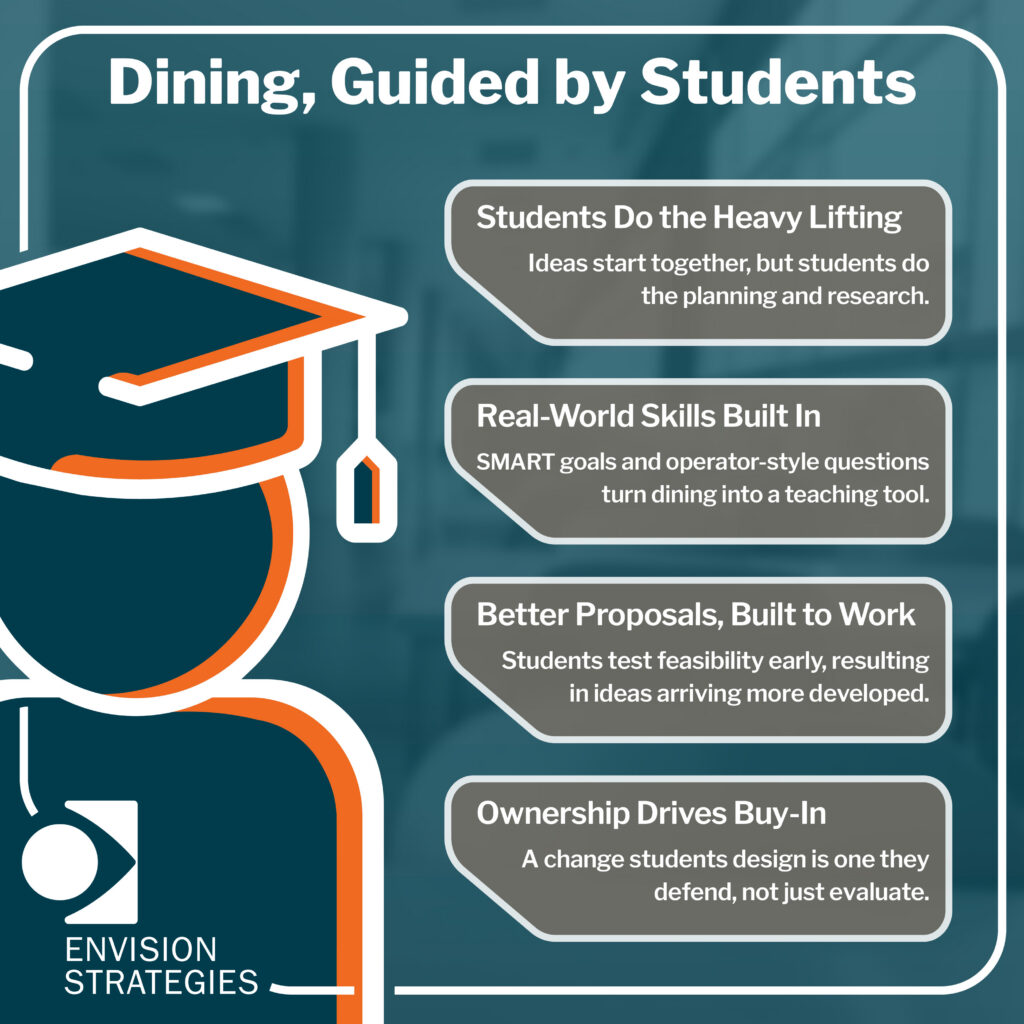
Here is the part that distinguishes the approach. Ideas get generated jointly, and then students carry the load.
“The ideas are generated together, but I rely on them to do the planning and to do the heavy lifting, and to do the homework.”
The questions he puts back to them are the ones any operator would ask a vendor or a consultant. What would this look like in practice? How would we measure whether it worked? He walks students through building SMART goals as an exercise in real world application.
The return on that is twofold. Proposals arrive better developed, with some sense of feasibility already attached. And students leave with a transferable skill, which turns the dining program into a teaching function alongside a service one.
Buy-In Follows Ownership
The payoff is not efficiency. It’s adoption.
“It now becomes a solution that comes from the bottom up instead of from the top down, so we get more buy-in. The communication and the campaigns come from the students.”
A change announced by dining services is an administrative decision students evaluate. The same change advocated by the students who designed it is something they defend. Surveys, focus groups and comment forms still run alongside all of this, and Erik names them as part of the toolkit. What they produce is data. The working group produces advocates.
That posture extends outward, too. Erik described his presence at the conference in exactly those terms: finding the partners who can meet the demands he and his students have identified on their campus.
Takeaways for Dining Leaders
- Treat transparency as part of the value equation. Students questioning value increasingly want to see purchasing and sourcing reasoning, not just a better price.
- Build a standing mechanism, not an annual survey. A working group meeting two or three times a semester catches issues while they are still fixable.
- Give students the planning work, not just a suggestion box. Asking what it would look like and how success would be measured filters ideas and builds skills at the same time.
- Scale is a variable, not an excuse. Small programs can convert feedback into action faster. Larger programs can replicate the structure at the unit level.