Reading Time: 4 minutes
Key Topics: Hospitality Talent, Student Wellbeing, Auxiliary Services Leadership, Workforce Development
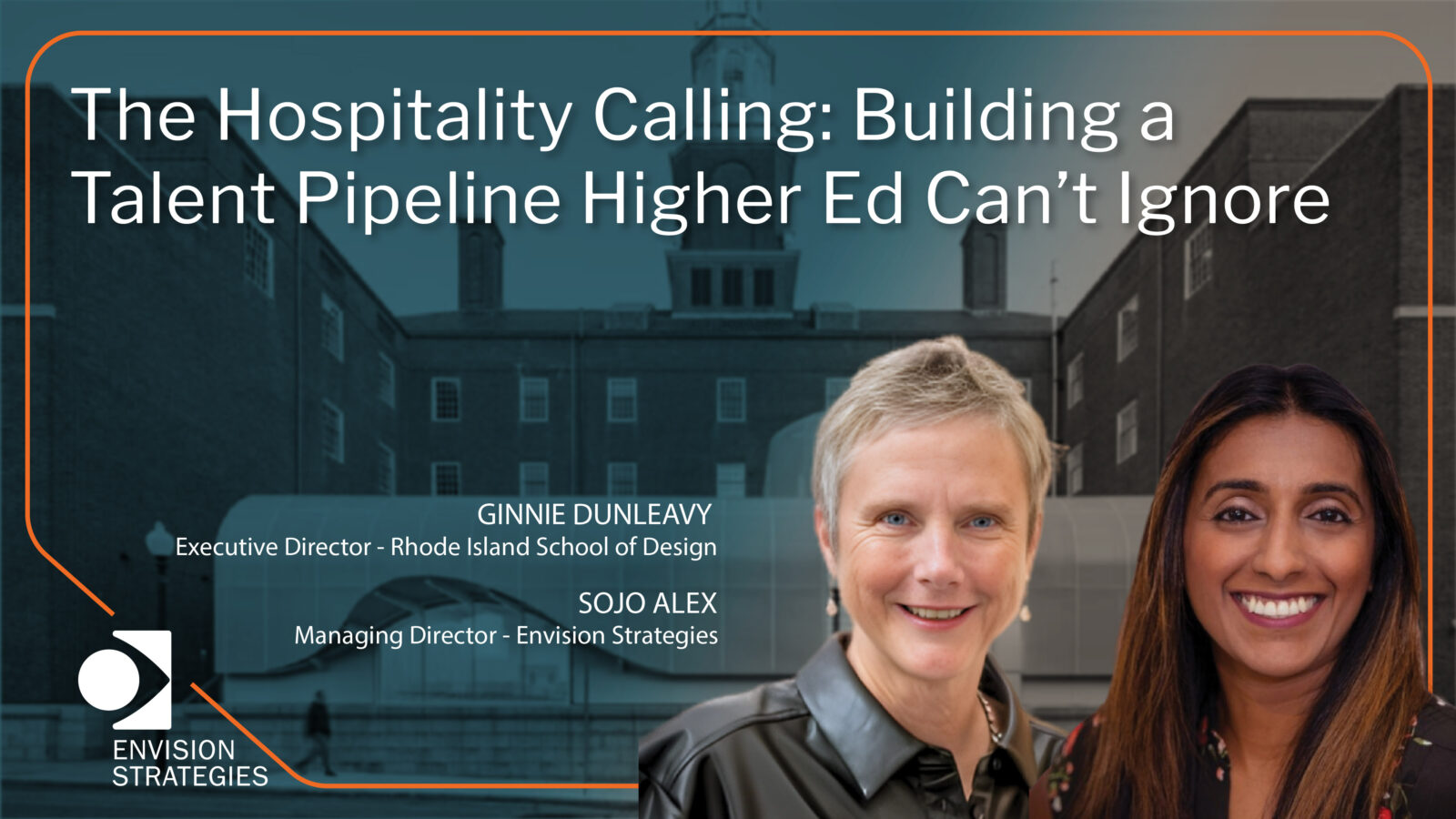
Featured Interview: Ginnie Dunleavy, Rhode Island School of Design
Watch the Full Video Interview Here
The RISD Portfolio
Rhode Island School of Design operates differently than most higher education institutions. As a small art and design school with majors ranging from architecture to ceramics to jewelry and fine arts, RISD’s auxiliary services portfolio reflects that uniqueness.
Ginnie Dunleavy oversees dining (including catering and vending), two specialized stores (one for two-dimensional art supplies and swag with a cafe, another resembling an upscale hardware store for making jewelry and sculptural work), mail services, warehousing, external conference and events, the RISD Buck program, a reuse initiative, the food pantry, and even an Airbnb property in Barrington.
Everything operates in-house. Everything falls under one leader. It’s a small school perspective where auxiliary services integrate deeply into student life and creative work.
The Magic Wand Answer
When asked what operational challenge she’d fix with a magic wand, Ginnie doesn’t focus on systems, budgets, or facilities. She focuses on people.
“I’m going to be very generous. I’m going to fix it across all of the auxiliary,” Ginnie says. “My magic wand would take people that have the gift of hospitality and tap them with the desire to do it in higher education.”
She describes this as an untapped market. People with genuine hospitality gifts often don’t know higher education exists as a career path. They default to hotels and restaurants without realizing campus dining and auxiliary services offer something fundamentally different.
Why Higher Education Hospitality Matters
The stakes aren’t just operational. At RISD, auxiliary services become a muse for students. The way staff engage, the attitude they bring, the care they demonstrate directly impacts student wellbeing.
“It is such a real opportunity to change students’ world and perspective,” Ginnie explains. “People’s attitude is really impactful right now with mental health challenges, wellness as a prime being.”
This is the value proposition that gets lost when hospitality professionals consider their career options. Hotels and restaurants offer one kind of impact. Higher education hospitality offers the chance to shape young lives during formative years, to become part of their creative and personal development, to contribute to student success in ways that extend far beyond service transactions.
Getting Intentional About Talent
Ginnie’s approach to building her hospitality team combines active identification with relationship development.
“I think you see the spark in certain folks that come to you for a reason or an event like this, you see that, and you try to build a relationship,” Ginnie says. “I think we have to be so much more active in identifying talent, identifying something that you see in a person that they might not even know that they have.”
She judges competitions for Rhode Island hospitality programs, standing in front of emerging talent with a compelling pitch: “Do you want to make really great money and not work every holiday?”
Ginnie came to higher education from hotels and restaurants after starting a family. She knows the trade-offs intimately. Higher education hospitality offers work-life balance that traditional hospitality rarely provides, along with the deeper mission of serving students during transformative years.
The Pipeline Problem
Higher education auxiliary services face a talent pipeline challenge. People with hospitality gifts pursue traditional hospitality careers because that’s what they know exists. Campus dining and auxiliary services remain invisible to many who would thrive in these roles.
Solving this requires auxiliary leaders to become active recruiters, not passive recipients of applications. It means building relationships with hospitality programs, attending industry events outside higher education, and articulating the unique value proposition of campus-based work.
It also means recognizing talent that doesn’t recognize itself. Ginnie talks about seeing something in people they don’t yet know they have. That requires observation, conversation, and willingness to invest in developing potential rather than only hiring proven experience.
What This Means for Auxiliary Leaders
Reframe the career conversation. Higher education hospitality isn’t a fallback from “real” hospitality. It’s a distinct career path with unique rewards: meaningful impact on student development, reasonable schedules, and the chance to work in creative, mission-driven environments.
Get out of your office and your industry. If you’re only recruiting within higher education circles, you’re missing the broader hospitality talent pool. Engage with culinary programs, hotel management schools, and restaurant industry events.
Develop the talent identification muscle. Learn to see potential in people before it’s fully formed. Build relationships with emerging professionals who show the spark but don’t yet know where it could lead.
Tell the student impact story. People with genuine hospitality gifts care about making a difference. Show them how campus work changes lives in ways hotels and restaurants can’t replicate.
The Calling Worth Finding
Ginnie describes hospitality in higher education as a calling. Not everyone has it. But those who do, and who find their way to campus dining and auxiliary services, discover work that matters in ways traditional hospitality rarely achieves.
The challenge for auxiliary leaders is making that calling visible, creating pathways for talented people to discover it, and building environments where hospitality professionals can thrive while serving students during some of the most important years of their lives.
About the Conversation:
This reflection draws from a conversation with Ginnie Dunleavy, Rhode Island School of Design, conducted by Sojo Alex, Executive Principal at Envision Strategies, at the 2025 NACAS national conference.
This reflection draws from a conversation with Matt Moss, Johns Hopkins University, conducted by Brendan Evje, Consultant at Envision Strategies, at the 2025 NACAS national conference.