
Reading Time: 4 minutes
Key Topics: Food Insecurity, Meal Plan Value, Retail Dining, Student Feedback
Featured Interview: Angela Rader, Director of Retail and Marketing Services at University Enterprises, Inc. California State University, Sacramento
Interviewed by: Sojo Alex, Managing Director, Envision Strategies
Watch the Full Video Interview Here
What Does Dining Look Like at Sacramento State?
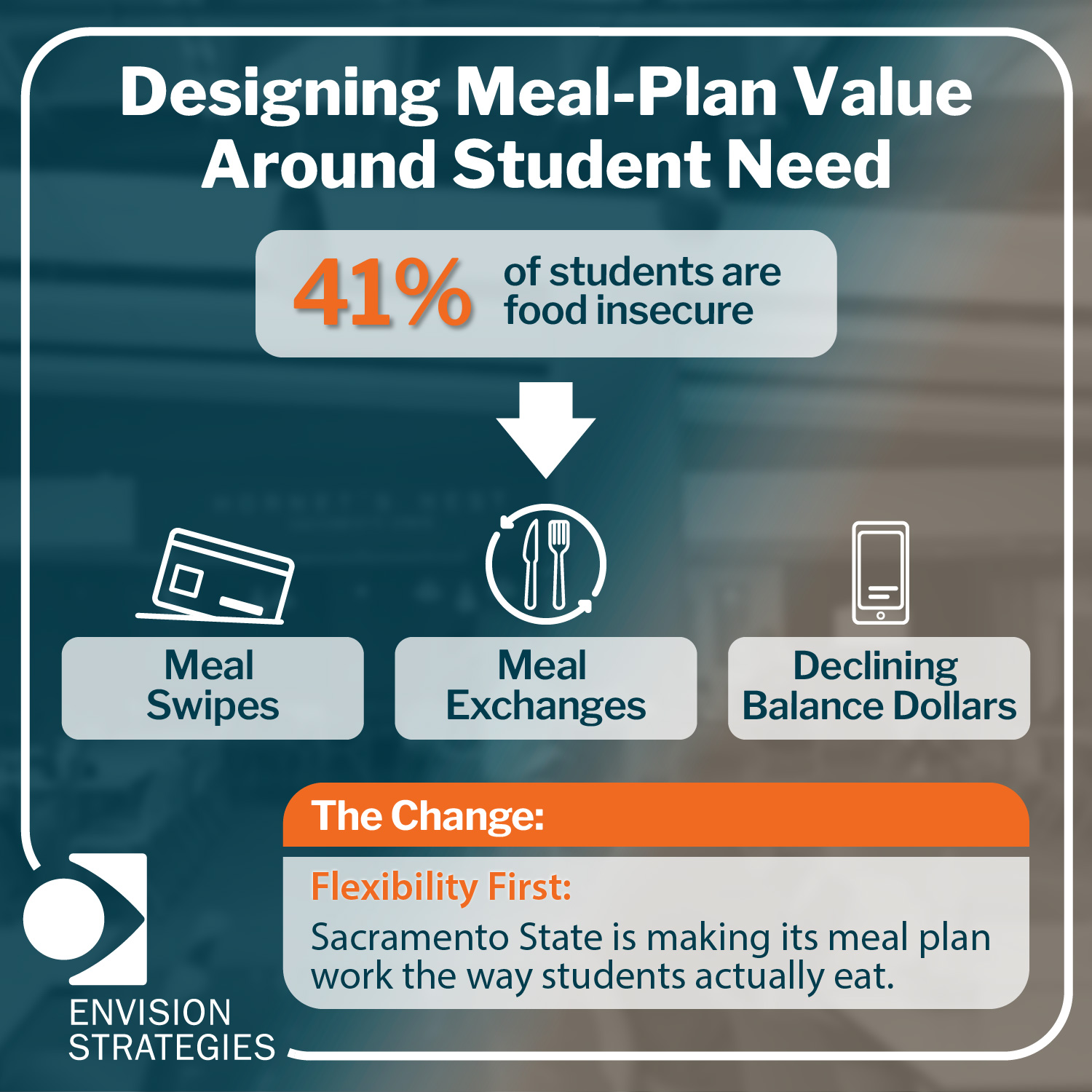
At Sacramento State, 41% of students are food insecure. That single number shapes nearly every decision Angela Rader makes about the campus dining program.
Rader serves as Director of Retail and Marketing Services, a role that puts her over a wide range of food and beverage operations. Alongside residential dining, the campus runs more than 20 retail locations. Some are operated by the university’s food service supplier, and others are subcontracted. “So it’s kind of a hybrid program,” Rader explains. Her responsibilities also extend to concessions and catering.
Roughly 2,200 students currently hold a meal plan. That group includes residents as well as voluntary meal plan holders who choose to buy in.
In a conversation with Sojo Alex, Managing Director at Envision Strategies, Rader shared how student expectations have shifted and how her team is responding.
What Has Changed Most About Student Expectations?
According to Rader, the biggest shift over the past two years centers on affordability. “We have a big focus on food insecurity,” she says. “So we look at that very conscientiously, and so value is absolutely critical right now.”
Students also want more flexibility in how they use their meal plans. Swiping into the dining commons is one piece of the picture. Many students hope to use their plan at retail locations across campus as well.
“They want a lot of options,” Rader notes. “They want to be able to use that meal program in a variety of ways.”
The challenge is balancing that flexibility against cost. Rader’s goal is to keep the program economical for the average incoming student, with particular attention to students who rely on financial aid.
How Does Sacramento State Deliver Value Through Its Meal Plans?
Sacramento State answers the call for flexibility by building several payment methods into its meal plans. Students can draw on meal swipes, meal exchanges, and declining balance dollars, which gives them more ways to eat across a hybrid campus.
A new residence hall now under construction adds another layer. Under a campus policy tied to the building, the university will offer a discounted meal program to roughly 230 students living in the residence halls.
“That is kind of new for us,” Rader says. The goal, she explains, is to offer a strong value component for students who might otherwise struggle to afford a meal plan.
For a campus where four in ten students face food insecurity, this kind of targeted pricing puts the meal plan within reach of the students who need it most.
How Does the Dining Team Learn What Students Want?
For Rader, surveys are the foundation. “Surveys are critical, just to get a pulse check on what they’re thinking, what their desires are,” she explains.
That feedback helps the team test whether the program is working. Rader describes the questions her team keeps asking: “Do we have the right mix of things? Is the program itself valued to them, or do we need to make some adjustments along the way?”
The same input shapes the retail side of the operation. With more than 20 retail locations on campus, survey results guide decisions about what the retail mix should look like and where changes could serve students better.
The result is a feedback loop. Student input informs the meal plan structure and the retail portfolio, and the next round of surveys shows whether those adjustments landed.
Key Takeaways for Dining Leaders
- Know your students’ financial reality: Sacramento State tracks food insecurity closely, and that data drives how the team defines value.
- Build flexibility into the meal plan: Offering meal swipes, meal exchanges, and declining balance gives students more ways to use their plan across residential and retail locations.
- Use pricing to reach students in need: A discounted meal program for roughly 230 residents shows how plan design can address affordability directly.
- Make surveys a regular habit: Ongoing pulse checks help confirm whether students value the program and where adjustments are needed.
- Let feedback shape the retail mix: Student input should guide which concepts belong in the portfolio, especially in a hybrid program with many operators.
At Sacramento State, value and choice are guiding priorities, and student feedback keeps the program honest. For dining leaders facing similar affordability pressures, Rader’s approach offers a practical starting point: listen first, then design the program around what students need.
Frequently Asked Questions
How many students at Sacramento State are on a meal plan?
Roughly 2,200 students hold a meal plan, including residents and voluntary meal plan holders.
What percentage of Sacramento State students are food insecure?
According to Angela Rader, more than 41% of Sacramento State students are food insecure.
What meal plan options does Sacramento State offer?
Students can use meal swipes, meal exchanges, and declining balance. The university also plans to offer a discounted meal program to roughly 230 residents of a new residence hall.
How does Sacramento State gather student feedback on dining?
The dining team relies on regular surveys to gauge student priorities, measure how students value the program, and guide decisions about the retail mix.


