Reading Time: 3 minutes
Key Topics: Student Engagement, All-You-Care-to-Eat Dining, Operational Efficiency, Employee Experience
Featured Interview: Elizabeth Riede, Appalachian State University
Watch the Full Video Interview Here
The Gen Z Narrative Gets It Wrong
There’s a persistent narrative about Gen Z students: they hide behind their phones, prefer digital interaction, and can only be reached through social media.
Elizabeth Riede, Executive Director of Campus Dining at Appalachian State University, isn’t buying it.
“I think what we’re finding is that students really do crave that engagement, that community, and they want it in our spaces, but they want it when they want it,” Riede explains. “They value their time in a different way. They value those relationships in a different way.”
At App State, a 21,000-student campus nestled in the Blue Ridge Mountains, Riede’s team has built their strategy around this insight: students want community on their own terms.
The Big Conversion
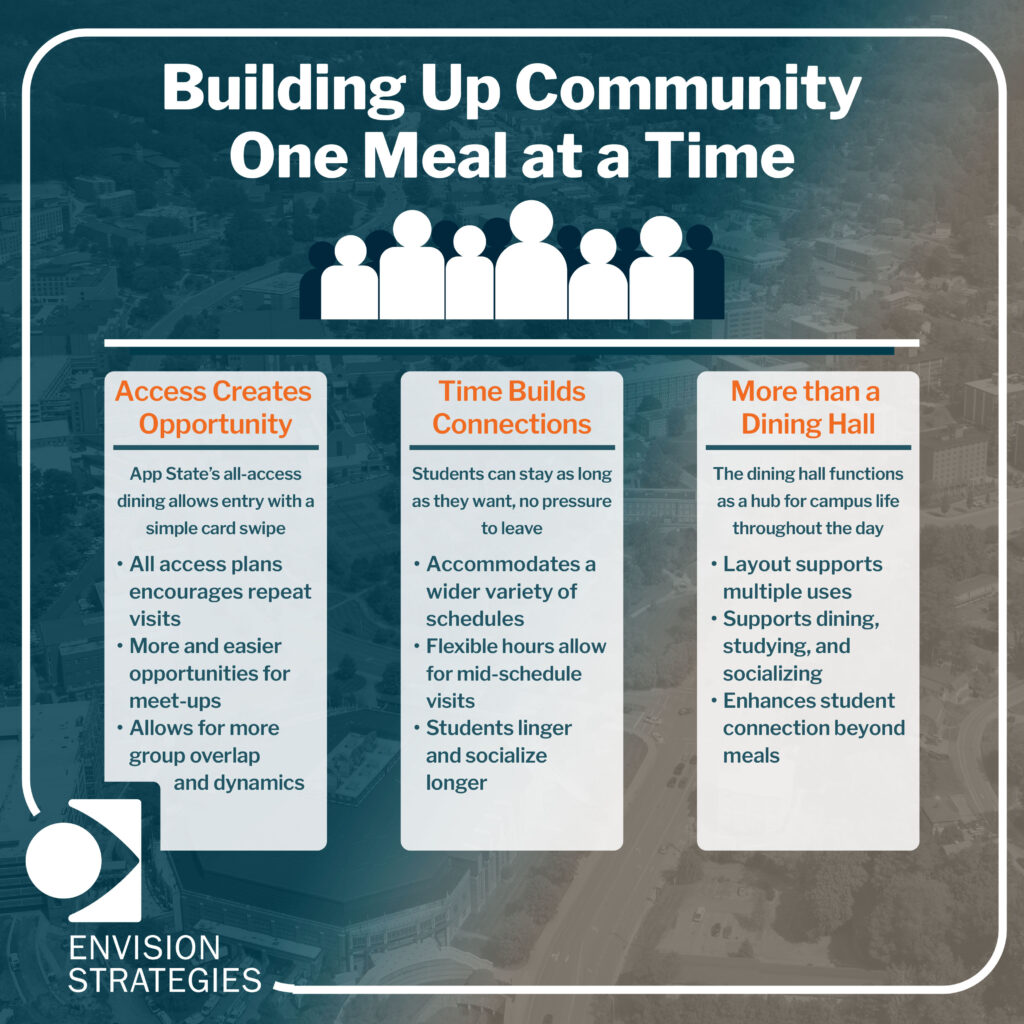
When Riede arrived at Appalachian State, the campus operated an all-declining-balance retail model. The program has since converted to include two major all-you-care-to-eat dining halls serving over 8,500 meal plan participants.
The shift fundamentally changed how students experience dining on campus.
“We’ve been amazed at how long our students want to be in community with each other,” Riede says. “Our average stay in our dining hall spans at least a meal and a snack.”
Students swipe in and stay. The dining hall becomes their kitchen, their living room, their dining room, their library. The campus has dedicated facilities for all those functions, but students find value in having everything in one communal space.
The Food Cost Question
The obvious concern with students hanging out for extended periods in all-you-care-to-eat venues: doesn’t food cost skyrocket?
“No, actually, it’s not,” Riede says. “People learn how to be in the space that they’re in.”
The first two weeks of each semester require some teaching. “All-you-care-to-eat doesn’t mean pick up the whole chocolate sheet cake and bring it to your table for you and your four friends to enjoy,” Riede notes.
Being in a community creates natural accountability. Students become respectful of the space and take what they truly want to eat. App State’s sustainability-conscious student body isn’t interested in piling plates with food they won’t consume.
The Magic Wand Answer
When asked what she’d fix with a magic wand, Riede doesn’t focus on student-facing improvements. She focuses on employees.
“There’s so much friction in their work right now, and I think we’re in such an awesome age of opportunity for us to make that job easier for them,” Riede explains. “It’s the right thing for them, it’s the right thing for the business, and it’s the right thing for our customers.”
Her vision: whatever frontline employees need to make their jobs so easy they don’t have to think about the mechanics, allowing them to focus on development and engagement.
The Student Employee Dynamic
App State operates with just over 130 full-time employees and more than 500 student employees. Students crave these work opportunities and view dining jobs as chances to develop life skills and competencies.
But this digitally native generation wants roles that leverage their unique skill sets, not just traditional back-of-house positions.
“We certainly do have a really strong student dishwashing crew, but anymore, that’s not necessarily the reason that they want to come to us,” Riede notes. “I think we have some really amazing opportunities to engage with them in ways that align with what they’re looking for.”
The challenge is creating student employment opportunities that match what this generation values in work experience.
Selling Your Story to Administration
When colleagues ask Riede how to gain administrative support for program investment, her advice starts with curiosity.
“Be curious about what interests them. What questions do they have? What perception of their program do they already have?” Riede suggests.
Then lean into what makes dining unique: hospitality. On her podcast “Human at the Counter,” Riede asks guests what humans can do that robots can’t replicate. Hospitality consistently emerges as the answer.
“I think anytime that you’re going to sell your program story, a lot of that’s tied up in how you make people feel and how you make your students feel,” Riede explains.
Her recommendation: bring administrators into your dining halls and student centers. Let them experience what you’re creating rather than just describing it.
The Community Investment
What App State demonstrates is that students will choose community when the environment supports it. Converting to all-you-care-to-eat dining was an investment in creating spaces where students could spend time together without transaction limits or time pressure.
The extended stay times prove students want this. The stable food costs prove it’s sustainable. The growth to 8,500 meal plan participants proves students value it enough to invest their own resources.
That’s the opportunity for campus dining programs willing to rethink assumptions about Gen Z students. Students aren’t hiding from community. They’re seeking it in spaces designed to accommodate how they want to engage.ent.