
Reading Time: 5 minutes
Key Topics: RFP Strategy, Stakeholder Engagement, Change Management, Dining Modernization
Featured Interview: Mindy Segal, Vice President, Envision Strategies, in conversation with Geoff Labe, Assistant Vice President for Operations, Lafayette College
Watch the Full Video Interview Here
Lafayette College, home to roughly 2,700 students in eastern Pennsylvania, faced a familiar challenge: a dining program that had served the campus well for years but was no longer meeting the moment. When Labe stepped into his role as AVP for Operations, overseeing both auxiliary services and facilities, one of his first responsibilities was leading a limited RFP process to reevaluate the college’s dining partnership. Working closely with Envision Strategies, Lafayette moved through a compressed timeline toward a new vendor relationship that has since reshaped how students experience dining on campus.
Listening Before Deciding
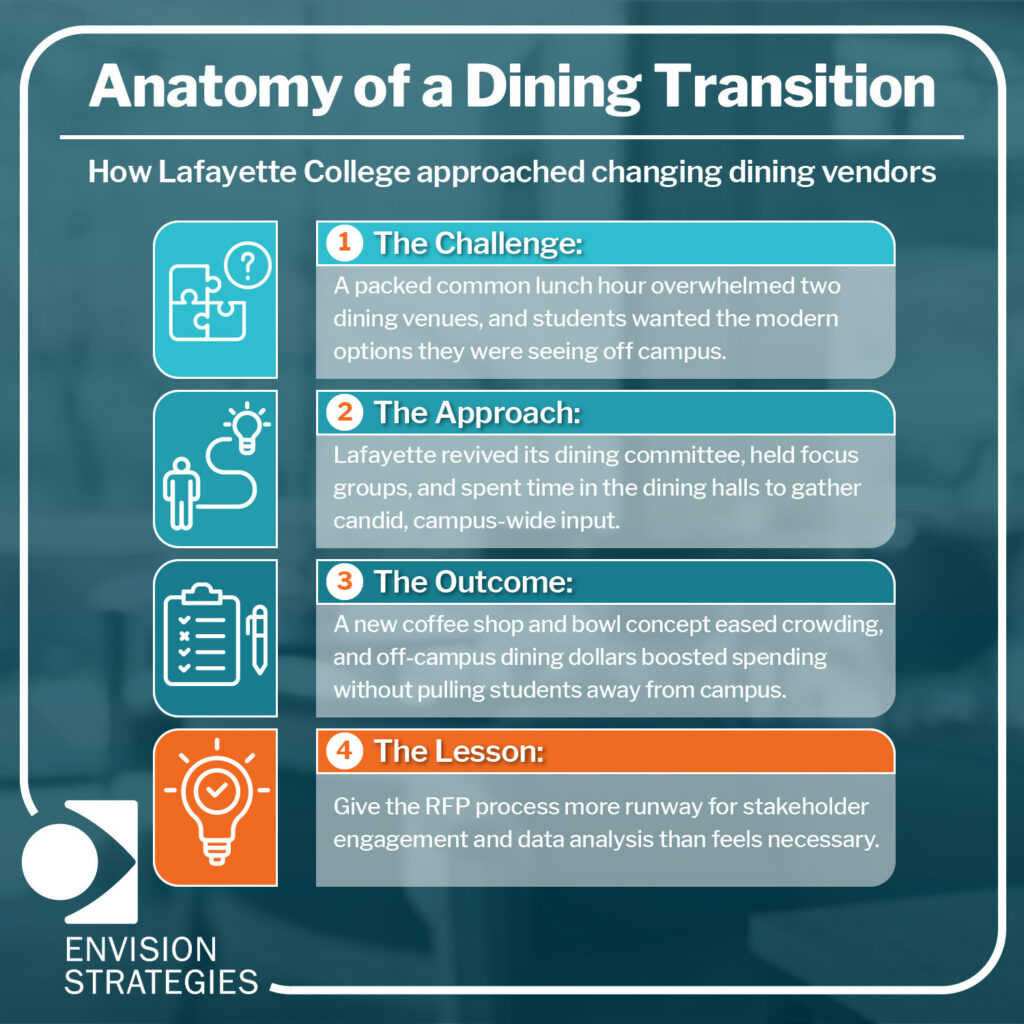
Labe’s approach centered on stakeholder engagement from day one. He revived a long-dormant dining committee, ran focus groups, and spent time in the dining halls themselves rather than relying solely on spreadsheets. That fieldwork surfaced problems that data alone couldn’t explain. A shared lunch hour was overwhelming two of Lafayette’s seven dining venues, leaving students improvising. “There’s nowhere to sit,” students said, even as they passed up open seats at large round tables built for group dining rather than individual meals.
Being new to the role worked in Labe’s favor. “I was able to get candid feedback from folks about what they were seeing in the dining program, what they wanted to see, and how they wanted to see it evolve,” he said. The academic division eventually adjusted the common-hour schedule, but the deeper fix came through menu changes and new venues that redistributed traffic across campus.
Modernizing the Program, One Venue at a Time
Two additions stood out. Lafayette opened a new coffee shop that now serves roughly 1,000 of its 2,700 students daily, and introduced a modern bowl concept that students had been requesting after seeing similar options off campus. Placed in a new residence hall near additional student housing, the bowl concept took off almost immediately. “I don’t think the doors were open for 10 minutes before it saw its first wave of traffic”, Labe recalled.
Lafayette also strengthened its connection to the surrounding Easton community by expanding where students can use their dining dollars off campus, including a shift to the GrubHub platform. Rather than pulling revenue away from campus dining, the change increased usage. “We don’t see much slippage in our usage on campus at all,” Labe said, noting that students and staff alike began adding more dollars to their accounts once they understood the added flexibility.
Partnership Through a Difficult First Year
Labe was candid that the first months with a new dining partner were rough. “Those first couple months were rough, and I think it’s really about seeing the light at the end of the tunnel and not the tunnel,” he said. Staffing transitions, menu adjustments, and the ordinary friction of a new operator learning a campus all played out in real time.
What made the difference, both Labe and Segal agreed, was a unified front. Lafayette and its dining partner communicated consistently with students, faculty, and staff, even when things weren’t yet running smoothly. “We intentionally made this change. We made the decision and we needed to own it with our new dining partner,” Labe said. That consistency extended to student government meetings and the campus newspaper, reinforcing a single message: transitions are hard, but the college and its partner were working through them together.
Looking back over two and a half years, Labe’s biggest lesson wasn’t about vendors or venues. It was about time. “I would recommend additional time for the RFP process, so that you can really get that community engagement, get that data analysis, spend time with all of the stakeholders a little bit more,” he said.
Key Takeaways
- Give the process more time than feels necessary. A compressed RFP timeline can work, but more runway for stakeholder engagement and data analysis pays off.
- Field time beats spreadsheets. Direct observation in dining halls surfaced problems that data and focus groups alone would have missed.
- New leadership can be an asset. Being new to a role can create space for candid feedback that longtime staff might not otherwise share.
- Distribute demand with intention. New venues placed strategically can relieve pressure on overwhelmed dining halls while giving students what they’re already seeing off campus.
- Community partnerships expand value. Extending dining dollars to off-campus restaurants built goodwill and increased overall spending rather than diverting it.
- A unified front matters most during transitions. Consistent messaging between the college and its dining partner helped the campus community trust the process, even through early bumps.


